Context
On 28th October 2020, two men were gunned down due to revenge in the town of Abudwak, and the perpetrators escaped. The town has a history of violent intra-clan conflicts, divisions, and in town green-lines; and it’s one of the three towns where, “connecting across divides: youth building peace in Somalia project” is being implemented by Somali Peace Line in partnership with Life and Peace Institute (LPI) – funded by UN Peace Building Fund. The Sustained Dialogue (SD) youth moderators targeted in the project felt threatened by the tension that has been rekindled among the Marehan subclans.
The SD sessions and other youth meetings were halted, university, and school attendance stopped and the tension built up among the communities due to fear of a chain of sub-clan revenge. The 20 SD moderators from across the conflicting sub-clans came together to discuss what they can do to prevent escalation of violent conflict as previously experienced. The following were the outcomes of the meeting:
- To organize members of SD group participants (120 members of both genders and from all the sub-clans in the area) to make contributions among themselves, visit the families of the deceased, give their condolences, and handover the contribution as a sign of solidarity during “the tacsi”(mourning) session.
- Organize a peace march in the town.
With the guidance of the SPL project officer in Abudwak, they analyzed the risks and the capacities related to the peace walk. They decided to involve other peace actors in the town to mitigate the risks and have a great impact on the community. The peace actors included influential figures of the community (authorities, elders, women, business, and the Ugaas), the schools, Somali National University – Galmudug branch, and the police. The mobilization team met with all actors, discussed the importance of the peace walk, the messages to deliver, and the roles of different actors.
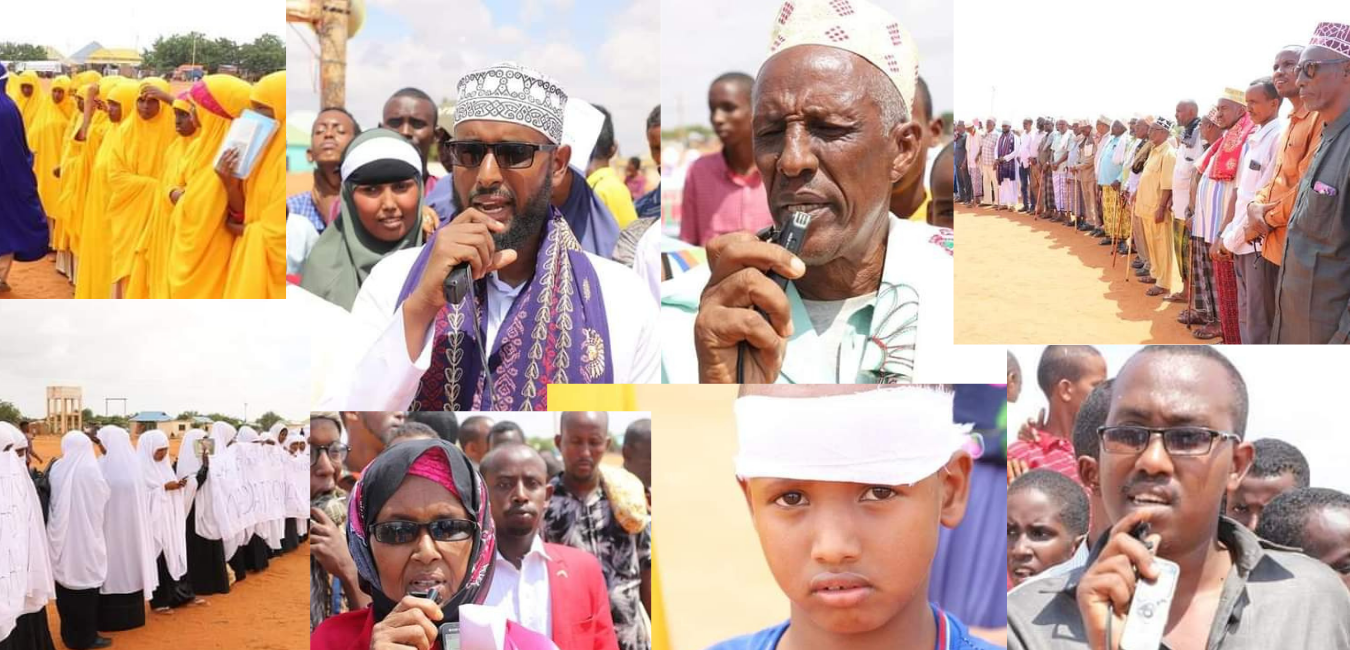
All actors agreed to have a peace walk in the town on 5th October 2020. Thousands of people from the communities (men, women, youth, and children) in the town, organized and mobilized by the SD youth group members, walked through the main streets of the town carrying placards with peace slogans: “PEACE IS LIFE”, “WITHOUT PEACE WITHOUT LIFE”; “DO NOT KILL YOUTH FELLOW BROTHER” “DO NOT SUPPORT KILLING” “MURDERERS SHOULD BE TRIED”, “WE DO NOT WANT HOSTILITY” “PEACE WORKS FOR US” etc. The walk ended at “Roob Da’ay Park” in the town, where the Ugaas, the District Commissioner, the chair lady of Abudwak women, the chairman of the district youth union, influential elders, SPL project officer, and other CSO members addressed the people. They denounced the killing, called for patience, strengthening peace and unity among the communities. They requested the neighboring communities and administrations to help in the search for the fugitives.
The Ugaas of the community in Abudwak, Ugaas Mohamed addressed the people and urged communities to stay calm and patient. He requested the families of the victims not to follow the path of vengeance, and he prayed that Allah gives them strength. He called for the administration – Galmudug, Puntland, Somali State in Ethiopia, and neighboring communities – to work with them in capturing and returning the murderers so that they face justice. He proposed to communities in Abudwak to reject the return of the murderers to the town if Diya (blood-money) is paid by their sub-clan. “We should never accept them to return to the town and live with us a year after their aggression after Diya is paid.”. Said the Ugaas. He called for the larger communities in Abudwak to preserve peace and stability and prayed for peace in the larger communities of Galmudug and Somalia as a whole. Those who participated in the peace march included youth, women, students, teachers, elders, district administration, security personnel, business owners. The initiative was applauded and it ended peacefully.
Quotes:
“It is the responsibility of every one of us to protect and safeguard peace. I urge you all not to harbor murderers and those who may cause conflict within our society. I pray for the dead to rest in peace and we pray to God to bring us peace.” said Abudwak District Commissioner.
“We urge our neighboring states Puntland and Ethiopian regional state to arrest the murderers who killed people in Abudwak and that is the only way we can work together on peace for our region. We urge the relatives of those murderers to work with us in capturing the killers and we tell them never to aid the murderers” said a member of the council of elders of Abudwak.
“Abudwak youth need peace. Those killed were youth and the killers were youth. It’s us who are dying. We need peace. The murderers are not for us. They are not our brothers anymore. They want us to be killed for their crimes. We say no” said the Chairman Abudwak Youth Union.
“We want peace in our town, and peace to prevail we have to work for it. That is why the youth in our program organized this peace walk. We will continue to work with the community. Peace is a collective responsibility, and everybody should take part in it. We (as an organization) will also stand by the community,” said SPL Project officer – Connecting across divides project.
“Greetings to the Ugaas, the elders, the district administration, and all who came together here. I acknowledge the organizers of this event. I denounce the murderers. My send condolence to families. I call for the family of the perpetrators to hand over the murderers,” the chair lady of Abudwak Women organization.
Somali Peace Line (SPL), in partnership with Life and Peace Institute (LPI), is implementing the “connecting across divided: youth building peace in Somalia” project in Abudwak, Jowhar, and Baidoa. The project is focused on diverse youth from all communities in these areas and facilitating for them to engage dialogue to action process applying sustained dialogue methodology. In this process, members of the youth groups will develop trust and friendship, experience self-change, and design actions to bridge communal divides and contribute to reconciliation and peacebuilding. The project targets 540 youth (270 female, 270 male) from the three locations.