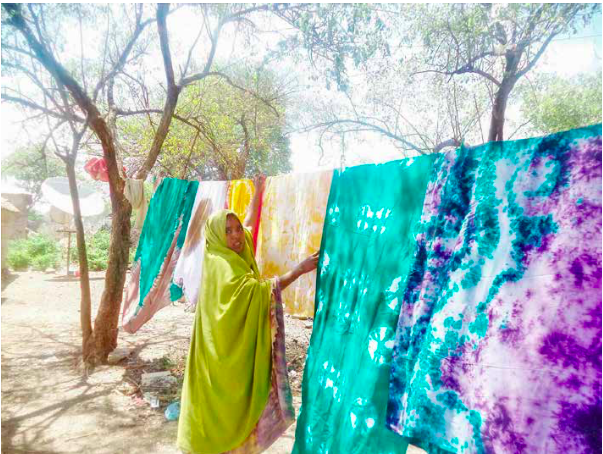
Jijo’s story: A young woman who gained peace through education and skills training.
Jijo lives with her family in Horseed village in the Bay region. As part of the Women, Peace & Security project. Jijo participated in the skills training opportunity instead of engaging in a dangerous journey to the Gulf. She has used the expertise she has acquired to provide for her family and works together with her mother.
“I am a 25-year-old unmarried woman. I live with my parents. I did not go to school. On many occasions I wanted to migrate to Yemen and then to Saudi Arabia to find work there, but my mother begged me to stay with her,
because the journey is dangerous. Over time I became desperate and felt hopeless. Our family did not have a regular source of income and my mother was just a local midwife in the village. Very few women giving birth at the time were seeking the help of midwife, because the Mother and Child Health Centres (MCHs) were already set up at every
section of the town.
Also, my mother could not read or write and this was a big disadvantage, because traditional birth attendants like my mother had to bring records of the new-borns to the MCHs for official birth registration and vaccination. Because she couldn’t do that, she could not receive delivery kits distributed to other traditional birth attendants, nor receive training by the MCHs.
The Chairperson of Horseed Section in Baidoa was informed about a training that would target poor families and displaced persons living in her section. She identified me as one of the trainees to be enrolled in the skills training project. I started by learning to read and write the Somali language for two months before I could be trained on tie & dye skills. I had to travel to the school every day far from my home, but AWC gave us some money for transportation, so that we could be in class at the centre on time. After six months of lessons and successful completion, we received start up kits that would enable us to set up our retail shops. I started off by tying and dying clothes and then moved to designing and staining some to make them more beautiful and unique for my customers. I could also dye old garments, sheets, shirts as well as men’s clothing that come out looking brand new.
My mother and I joined forces to work together in providing midwife services to expectant women. I persuaded my mother to continue doing her midwifery work, and I would do the registration of the new-borns. Eventually, my mother and I received training on the registration exercise and procedures, as well as the use of delivery kits. We continue to maintain a good relationship with the MCHs. My mother assists women undergoing normal labour conditions, and if she notices any complications, we quickly ask the MCH to send an ambulance to transport the patient to a proper health centre for further treatment and care.
I am thankful for the expertise I have acquired because I have a job with an income now. Although I live with my mother, I am no longer waiting for her to feed me. Now I am in a much better position, because I can earn between 210,000 and 400,000 Somali Shillings a week (equivalent to $11-20). I pay the house rent, electricity and water bills. I also pay a contribution as a member of the community, for example when coming together for weddings. I can also wear clothes like my neighbours who are better off and have both parents alive. I am now independent and self-sufficient.
I have become a popular person in my community. My peers admire and look up to me. They would always ask if I could help them join the skills training programme to also learn and acquire such useful abilities. I still dye clothes in the village and am planning to enrol in an adult school and then hopefully receive midwifery training. My mother will soon retire and stay at home, but I want her to transfer her skills to me so I can replace her. I no longer think about making the dangerous trip to Yemen and Saudi Arabia. I am glad my mother advised me against it.”